

McGill University · PMHA Alliance
The StaMPS Data Framework is an international expert-consensus initiative focused on standardizing data collection in psychedelic science. It is developing a purpose-sensitive framework to guide what data should be collected, when, and in which contexts, in order to support more rigorous, consistent, and equitable research and practice.
Explore the project


The initiative in numbers
The problem
Why standardize data collection in Psychedelic Science?
Psychedelic therapies are complex interventions: a pharmacological substance is delivered within a psychosocial protocol, shaped by preparation, support, set and setting, and follow-up care. As these treatments move from controlled clinical trials toward broader implementation, the data being collected across studies, clinics, and jurisdictions remain strikingly heterogeneous. Sites vary widely in what they measure, how they measure it, and when — undermining comparability, hindering evidence synthesis, and delaying clinical, regulatory, and policy decisions.
Existing reporting guidelines each cover part of the picture — trial reporting (CONSORT and its extensions), regulatory conduct (Good Clinical Practice, FDA guidance), intervention description (TIDieR, WIDER), set and setting (ReSPCT), health economics (CHEERS, CReDECI 2), and group-based interventions (GB-BCI) — but none was designed for the full scope of psychedelic care, and no consensus exists on which of their elements are essential in this field.
The StaMPS Data Framework addresses this gap through the convening of an international expert panel to define, through structured consensus, the Core data domains (i.e., the minimum essential set whose absence would raise serious concerns) and Supplementary domains (i.e., valuable but not strictly necessary) for psychedelic medicine. These data items span participant characteristics, baseline assessment, mindset, intervention characteristics, intervention integrity and safety, treatment experiences and process, outcomes, and research methods and implementation.
Three purposes
Purpose-sensitive by design
The project is built on the premise that the appropriate data depend on why they are being collected. Experts strongly endorsed three primary purposes of data collection (mean appropriateness rating 6.5/7), which anchor the framework:
Clinical
Guiding Therapeutic Practices. Data is collected to directly improve the safety and effectiveness of psychedelic therapy practices, for both well populations and patients.
Academic
Academic Research & Knowledge Development. Data is collected to advance scientific knowledge on psychedelic drug effects, mechanisms, efficacy, and safety.
Economic
Economics & Health Policy. Data is collected to inform psychedelic policy decisions regarding access, regulation, funding and insurance coverage.
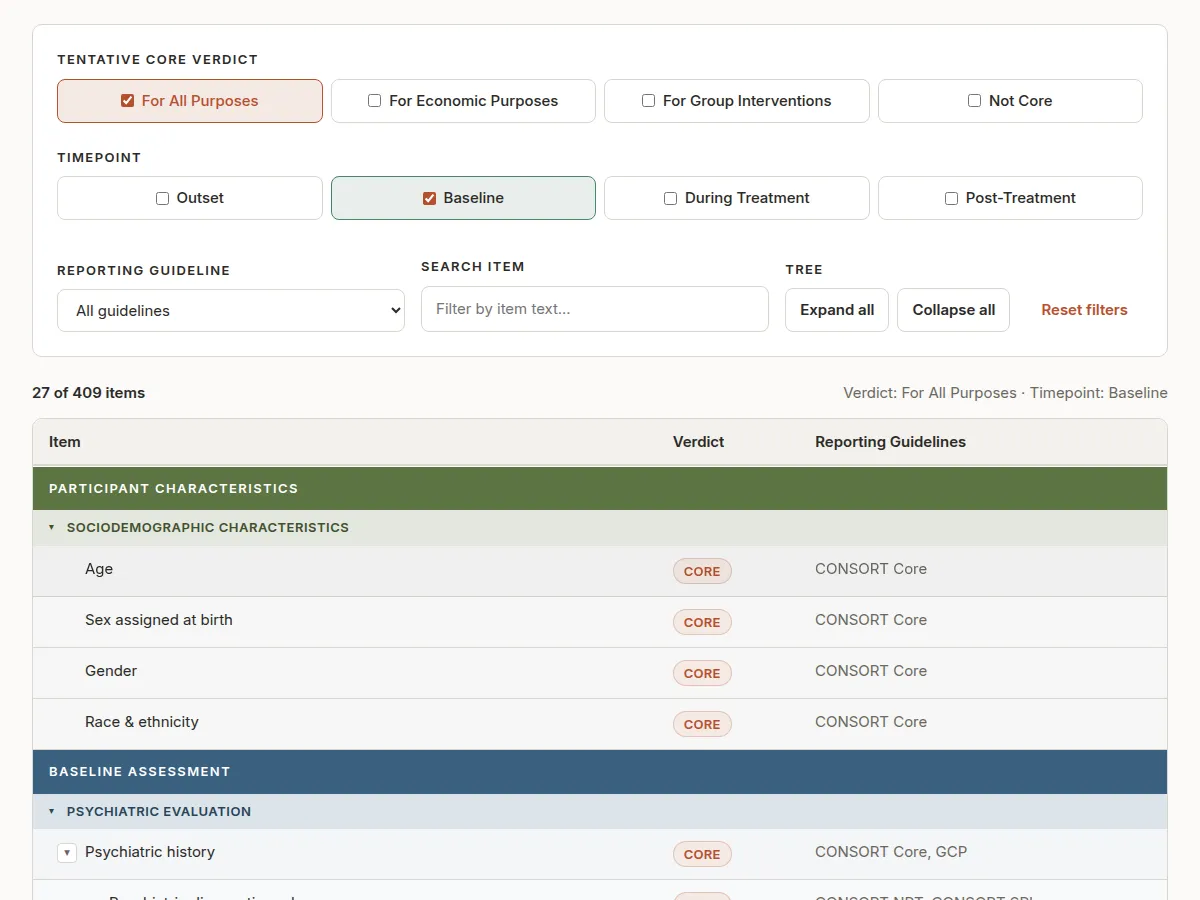
The consensus process has likewise favoured conditional, modular recommendations over one-size-fits-all mandates: for example, experts preferred that group-intervention items become Core only when therapy is delivered in groups, and that health-economic items be Core for economic purposes only. The interactive tool reflects these specifiers directly.
Method
Study design
The project uses a modified Delphi consensus methodology adapted from Core Outcome Set (COS) development, with four planned rounds:
| Round | Focus | Status |
|---|---|---|
| Round 1 | Open elicitation: purposes of data collection, timepoint definitions, key design factors, and candidate Core/Supplementary domains from expert free-text responses. | Complete |
| Round 2 | Guideline harmonization: six structured proposals for classifying items aligned with 12 established clinical and research guidelines. | Complete |
| Round 3 | Item-level ratings of the many remaining candidate items without a Core verdict, refined by purpose and timepoint. | Upcoming |
| Round 4 | Final consensus, thresholds, and ratification of the StaMPS Data Framework and interactive tool. | Upcoming |
Data-collection timepoints follow the expert-endorsed "By Timing" categorization — Outset, Baseline, During Treatment, and Post-Treatment — selected in Round 1 from four alternatives (mean usefulness rating 5.96/7; preferred by ~44% of experts).
Get involved
Help shape the framework
We actively welcome feedback from researchers, clinicians, policymakers, people with lived experience, and other stakeholders — on the framework's content, the tool's usability, and anything we may have missed.